

2020 Certified Traffic Marshalling and Traffic Management
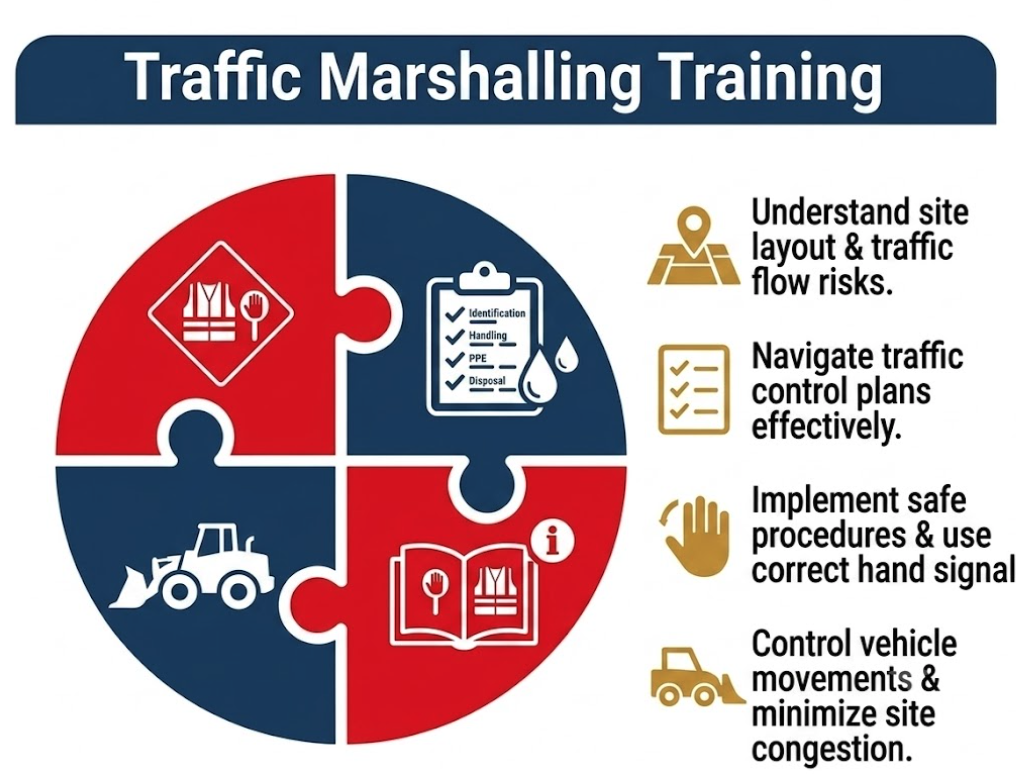
This course gives learners a practical understanding of workplace traffic management and the role of a traffic marshal or banksman in controlling vehicle movement safely. It covers site layout, vehicle and pedestrian segregation, traffic control plans, reversing, turning areas, delivery zones, one-way systems, communication, supervision and standard signals. The training is suitable for workplaces where moving vehicles, plant, deliveries or public interfaces create risk.
COURSE DETAILS
- Best for: Traffic marshals, banksmen, site supervisors, logistics teams, construction teams, yard operatives, warehouse staff and anyone involved in workplace vehicle movement.
- Delivery: Available for workplace, classroom or site-based delivery, with practical discussion and exercises linked to your operating environment.
- Certification: 2020 Certified Traffic Marshalling and Traffic Management training.
- Next step: Enquire below and our team will confirm dates, delivery options and group requirements.
WHO IS THIS COURSE FOR?
This course is suitable for any organisation with workplace transport risks, including construction support, logistics, warehousing, yards, manufacturing, retail delivery areas, events, facilities, property, waste operations and sites where vehicles and pedestrians interact.
WHAT YOU SHOULD EXPECT FROM THIS COURSE
Learners will work through the core controls that help prevent workplace vehicle incidents, including planning, segregation, visibility, communication, signage, reversing controls and emergency arrangements. The session uses practical examples to show how traffic marshals support safe movement without stepping outside their competence or putting themselves at risk. Organisations can use the training to support safer site logistics, delivery management and vehicle/pedestrian interface controls.
LEARNING OUTCOMES
- Understand the purpose of traffic management plans and workplace vehicle risk assessment.
- Recognise how segregation, signage, markings, lighting and speed controls reduce risk.
- Explain the role and responsibilities of a traffic marshal or banksman.
- Use clear communication principles and standard vehicle manoeuvre signals.
- Identify safe controls for reversing, turning areas, loading zones and changing site layouts.
- Understand how gradients, weather, visibility and public interfaces can affect traffic management.
- Know when to stop work, escalate concerns and report unsafe vehicle movement.
KEY TOPICS COVERED
- Traffic management planning and risk assessment
- Segregation of vehicles and pedestrians
- Site layout, traffic flow, turning areas and one-way systems
- Signage, markings, lighting, gradients and weather controls
- Speed control, driver competence and supervision
- Banksman duties, reversing controls and standard hand signals
- Delivery zones, public interfaces and operational change
- Emergency planning, reporting and stopping unsafe work
Expected time dedication
Course duration can be adapted to your site and training needs. It is normally delivered as a practical awareness session with workplace examples and exercises.
Assessment method
There is no formal exam. Understanding is checked through trainer-led questions, discussion, signal practice, scenario-based activities and a short knowledge check.
Entry requirements
There are no formal entry requirements. Learners should have a good grasp of the English language and should be able to follow site safety instructions. Suitable PPE may be required if site-based practical activities are included.
This is a course we can provide at your site – get in touch using the enquiry form below.
FAQ’s
It is intended for traffic marshals, banksmen, supervisors, logistics teams, warehouse staff, yard operatives and anyone involved in controlling or managing workplace vehicle movement.
Course duration can be adapted to the site and training requirement. It is normally delivered as a practical awareness session with workplace examples and exercises.
Yes. Site-based delivery is often useful because the trainer can relate the learning to your traffic routes, pedestrian areas, delivery arrangements and operating conditions.
The course covers risk assessment, traffic control plans, vehicle and pedestrian segregation, signage, lighting, speed control, reversing, turning areas, delivery zones, communication, standard signals and emergency arrangements.
Yes. Learners cover standard vehicle manoeuvre signals and the importance of clear communication between drivers and marshals.
There is no formal exam. Understanding is checked through questions, discussion, signal practice, scenarios and a short knowledge check.
Learners receive a 2020 Safety Training certificate for Traffic Marshalling and Traffic Management training.
Yes. The course can support construction, logistics, warehousing, manufacturing, retail delivery areas, events, facilities, yards and other workplaces where vehicles and pedestrians interact.
Complete the enquiry form on this page and include your preferred dates, location, number of learners and any site-specific traffic risks you would like covered.
ENQUIRE ABOUT THIS COURSE
If vehicles and pedestrians interact on your site, clear traffic controls and trained marshals can make a significant difference. Complete the enquiry form below with your site type, number of learners and preferred dates, and our team will discuss the most suitable training option with you.